- 520g Matthews Cotswold Strong White Flour
- 130g Waitrose Duchy Organic Stoneground Wholemeal Flour
- 505g water – 78%
- 14g salt
- 4g yeast
This is my first loaf using Ken Forkish’s pincer method, as described in his recent book Evolutions in Bread. This book builds on his first book, Flour, Water, Salt, Yeast, providing recipes mostly for loaves baked in pans, which is what I do. It is all manual and doesn’t use a mixer. There is actually not much kneading involved, and it uses a smaller amount of yeast than usual and a longer bulk fermentation (around 3 hours). While it’s not a no-knead bread, which has minimal mixing and does all its work overnight, it’s pretty hands-off.
This is what Forkish calls standard bread, the first recipe in the book, and the simplest. I adapted his recipe, increasing from 500g total flour to 650g. I usually like to have about half wholemeal flour in my loaves, but for the first time, I just used his 4–1 proportion. This is quite high hydration at 78%, and If I wanted to use half wholemeal, I’d probably need to go to 80%.
The manual mixing – what Forkish calls the pincer method – takes about five minutes, so the overall amount of prep work is quite short. This said, the dough was messier than expected, and the process was nothing like he shows in this video.
Forkish says to let the dough rise for around three hours, to two-and-a-half to three times its initial volume, and about three hours after I finished mixing, it was around that volume. The dough was interesting. I put some flour on it, and it was quite fluid, yet held together well. I stretched it a couple of times, then rolled it and put it in my pan to rise.
After about an hour of rising, I turned on the oven; it takes ten minutes to get to 200º. I baked the loaf for 25 minutes with the cloche and 25 minutes without.
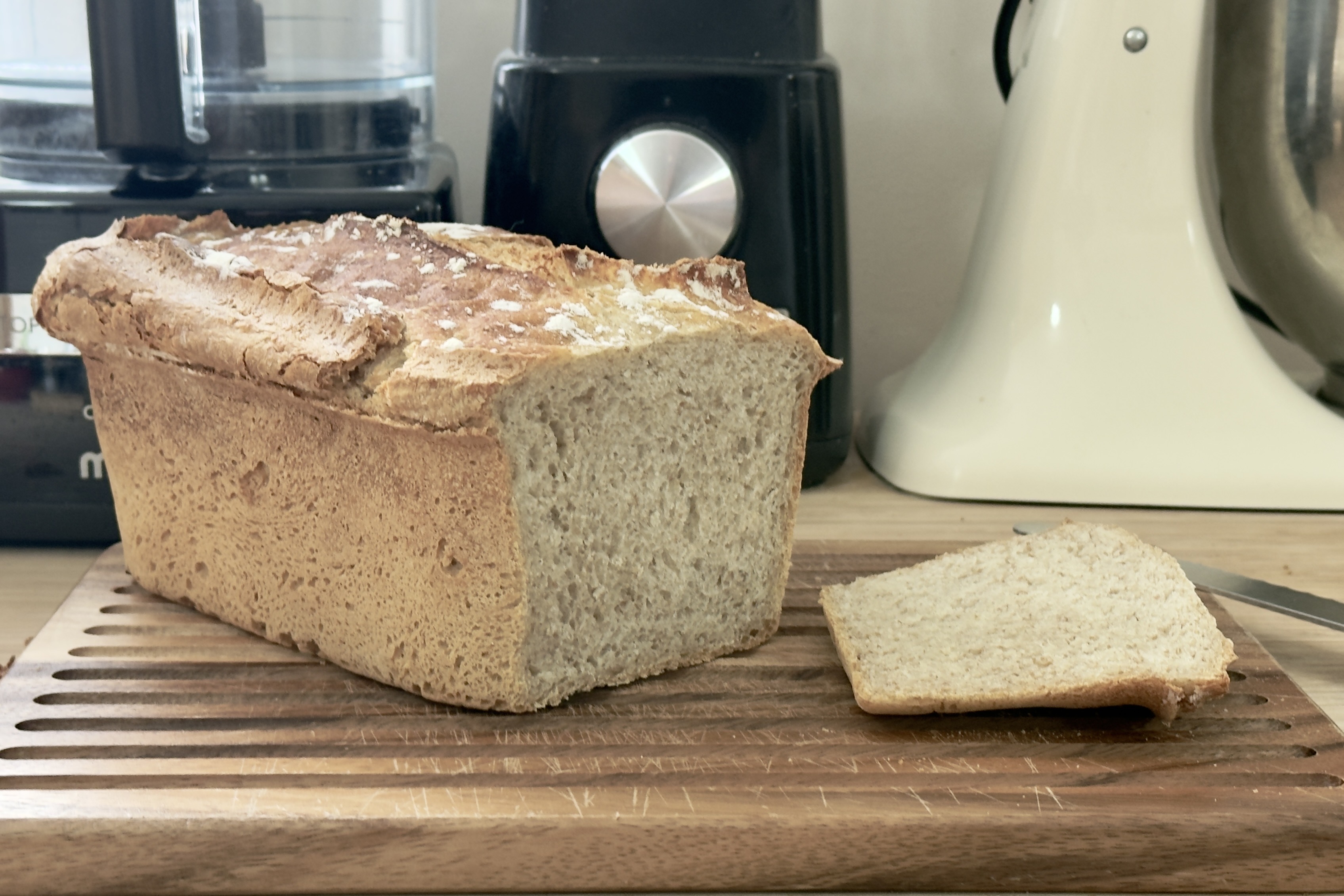
Well, dear reader, this loaf was an aesthetic failure. It rose so much that it hit the top of the cloche and spilled over the side of the pan, so it was first hard to get the cloche top off, and second, hard to get the loaf out of the pan when it was finished. It is tasty, and the crumb is excellent, but I don’t really find it to be more flavorful than bread made with other techniques. I don’t feel that the longer fermentation made much of a difference to the bread’s flavor, but the crumb is nice and chewy, closer to a sourdough than a standard yeast bread.
I should have tried the recipe with the 500g flour as in the book, but I was worried it wouldn’t be enough for my pan. But the dough much more hydrated, and rising more than usual in the oven, it made a mess. This said, I understand the point of the technique and longer bulk fermentation, but I might want to try with a bit lower hydration. It’s hard to judge, because you don’t know the humidity of the flour, so there could be a difference of a couple of percent hydration between dry flour and more humid flours, depending on where you live and the ambient humidity.
Leave a Reply