- 240g Matthews Cotswold YQ Population wholemeal flour
- 460g Matthews Cotswold Churchill White Flour
- 525g water – 75%
- 14g salt
- 7g yeast
All of my loaves this year have been using my Netherton Black Iron Loaf Tin Cloche. This is a very practical loaf pan that makes large, 1kg loaves that are ideal for toast and sandwiches. I wanted to try something different, and I came across a no-knead recipe from J. Kenji López-Alt, author of an interesting cookbook called The Food Lab, which looks at the science behind cooking.
His recipe is not new, and it’s based on a recipe from baker Jim Lahey that was popularized by Mark Bittman in the New York Times some 20 years ago. Essentially, instead of kneading the bread, you let time perform the chemical changes that create a gluten network. He recommends a 12- 16-hour fermentation at room temperature, then three-five days in the refrigerator, but I decided to skip the latter long fermentation. I admit that I was hesitant about this long room-temperature rise; I had made no-knead bread before, but only with the dough refrigerated. I was worried that it would over-proof.
This loaf is cooked in a pre-heated Dutch oven, which I’ve never been comfortable with because of the risk of burning. I decided not to preheat the Dutch Oven for an hour, because electricity is not cheap, and it doesn’t seem necessary. When I make pan loaves, it takes 10 minutes for my oven to go from cold to 200º C, the temperature I use in my fan oven. Kenji’s recipe says, “bake in a preheated 450°F (230°C) Dutch oven for 15 minutes with the lid on. Remove the lid, and continue baking until it hits around 209°F (98°C), 30 minutes or so.” I let my Dutch oven preheat for 20 minutes, and then added the dough.
I used the same combination of flours as in my last loaf. I mixed the dough at around 4 pm, then, when I got up in the morning, the dough showed signs of being over-proofed. It was very slack and had a slight smell of alcohol. I gave it a few folds, then shaped it and put it in a banneton.
When I looked up the original no-knead recipe, I saw that the amount of yeast was minimal. Instead of 7% here, it was 1%. Could this recipe have been published and displayed on the website for this long with a mistake like this? My dough did look like the photo on the website, at least on the surface. The recipe says that after the long bulk fermentation, there is “a slack, easy-to-work dough that stretches beautifully,” and this was certainly the case. It was similar, or even slacker, than high-hydration doughs I’d made in the past.
The recipe said it should rise for two to four hours after being shaped, but I doubted that this would be successful; I let it rise for one hour, then baked it.
I put my Dutch oven in the oven and turned it on at 200ºC for 20 minutes. I baked for 20 minutes, then removed the lid and baked for another 25 minutes. It didn’t seem done enough, so I put it back in the oven for five minutes.

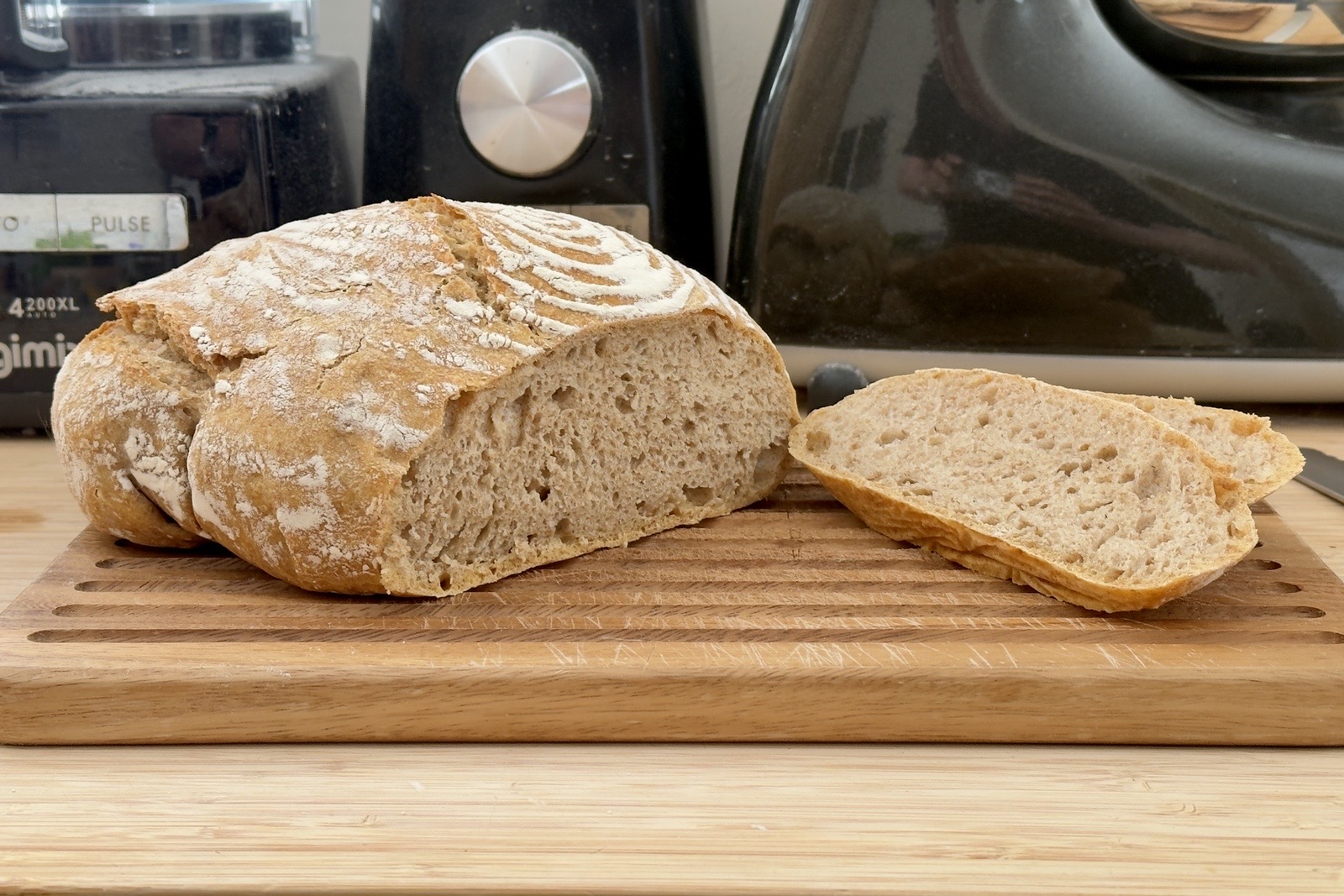
At first glance, the loaf didn’t look great. It had spread out too much, though the Dutch oven kept it from getting flatter. It seemed to cook well on the outside, and smelled all right, though with a tinge of alcohol, or almost a sour smell.
The resulting loaf is quite chewy, and has a bit of a flavor to it; sour, alcohol, I’m not sure what it is. My guess is this is from the over-proofing. Oven spring was not very good, though the loaf isn’t gummy. The crumb is dense, but not too much. All in all, this is not a successful loaf, but it is edible.
Leave a Reply