Poolish:
- 200g Matthews Cotswold Stoneground Traditional White Flour
- 200g water
- 0.5 g of instant yeast
Dough:
- 100g Matthews Cotswold Stoneground Traditional White Flour
- 400g Matthews Heritage Broadway wholemeal bread flour
- 304g + 30g water (76 %)
- 6g yeast
- 14g salt
I wanted to try to make a loaf with a poolish. This is when you take some flour and water, and a tiny bit of yeast, and you make a pre-ferment. It’s not quite like using a sourdough starter, because it’s not aged or sour, but using a pre-fermented starter can give the loaf deeper flavors.
You prepare the poolish the night before, using equal parts flour and water and a small amount of yeast. You mix that in with the water for your recipe, and then add the flour, yeast, and salt as you would normally.
The poolish smelled wonderful when I uncovered it, as it had almost 12 hours to work on the stoneground white flour that I used. For the rest of the dough, I added some more stoneground white flour, and the rest – about 57% of the total flour – was stoneground wholemeal flour, the same as I used in my last loaf.
I had guesstimated that 72% hydration would work with this combination, but when I added all the flour to my mixer, it was clear that it wasn’t quite enough, so I added another 30g of water, bringing it to 76%. After about 12 minutes of mixing, I folded the dough a few times, then set it in a box for bulk fermentation. There was frost on the ground this morning, and my kitchen was chilly, below 20º, so I let it bulk ferment for 50 minutes.
The dough was very elastic, and I gave it a few folds, then put it in my pan to rise. I left it for about 40 minutes, and it didn’t rise as much as loaves usually do, but it felt ready, so I put it into the oven for 25 minutes with the cloche on, and 20 minutes with it off.
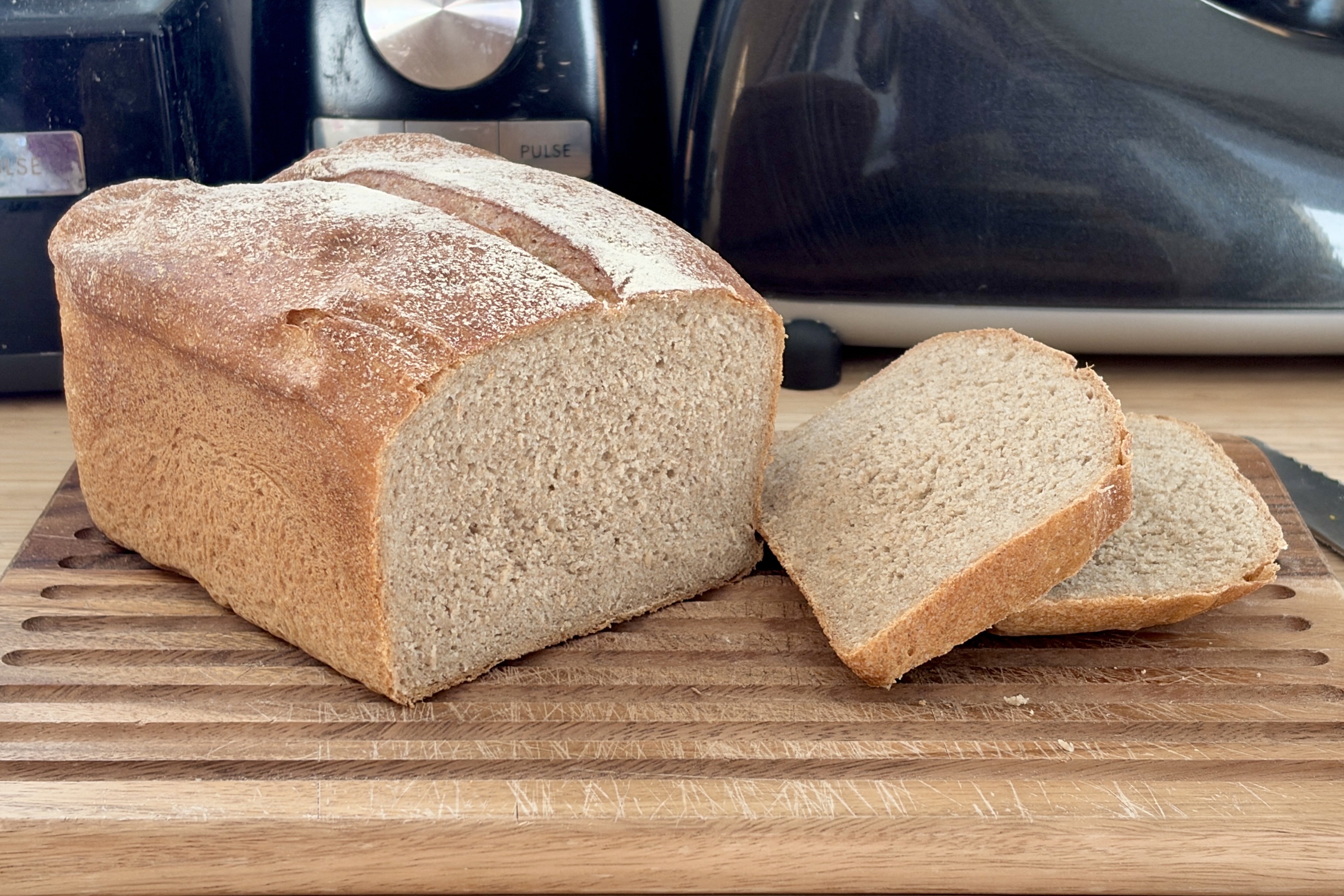
The loaf rose less in the pan and in the oven than usual. This could be because I used less yeast than I would otherwise – 6g instead of 8g – thinking that the poolish would compensate enough. I put the poolish in a cupboard that has heating pipes leading upstairs, but the heat wasn’t on overnight, so those pipes were only warm a bit in the evening after I made the poolish, and a bit in the morning before I started making the loaf.
The resulting loaf was delicious, nice and chewy, with lots of flavor, but it’s hard to compare it to the memory of other loaves to know how much difference the poolish made. I would need to experiment, making one loaf with poolish and another with the same flour, without it.
The crumb is tight because the dough didn’t rise enough. So it either needs a much longer second rise, or a bit more yeast in the mix. The top crust collapsed a bit after cooling, so there must have been some bubbles in the dough. All in all, a fine loaf, but one that leaves lots of open questions.
Leave a Reply